Tag: internet
Duany on Landscape Urbanism
This lecture by Andres Duany is probably the most important lecture on the topic of Landscape Urbanism this year. The essential takeaway of the talk is that New Urbanism has become aware of the landscape-informed design practices that have been percolating up into practice and academia – and the better practitioners are about to engage them, either as an opponent or an ally. It’s easy to dismiss the lecture as a retardaire hit job on the movement, but the critique heralds the conflict and dialogue that will come along with the completion of landscape urbanist projects, the dissemination of its ideas, and the reaction of architects outside of academia.
I could write reams about his perspective on history or the take on form or why he excludes so much of the interest in infrastructure. I am tempted to get into a CNU kremlinology of what compliments are genuine (he was, after all, the co-founder of Arquitectonica) and which are the clever rhetorical devices of a very smart and charismatic man. Instead, it’s just better if you watched it yourself.
Hat tip: John Massengale.
Conservative Socialism for the Kids

I read in the Post this afternoon that a 13-year-old Germantown girl was punished and ridiculed for refusing to say the Pledge of Allegiance Predictably, there have been accusations of anti-Americanism, Liberalism, and the Mohammedan heresy, among other things.
With all that puffing in mind, it’s worth bringing up the origins of the pledge. It was written by a Francis Bellamy, a Massachusetts socialist and flag salesman in the 1890s who was aiming to instill national pride. A product of the Civil War generation, he also wanted to emphasize the permanent national unity of the United States, which was much looser in concept before Appomattox. The pledge was meant to be accompanied by a salute, pictured above, and it was a major component of a national pride celebration held on – of all days – Columbus Day.
So, it might not quiet any shriekers, but the next time someone tells you we should force children to pledge their loyalty to the state, please kindly do remind them of what the Bellamy salute looks like.
ARD Creates Biased Poll, Still Loses
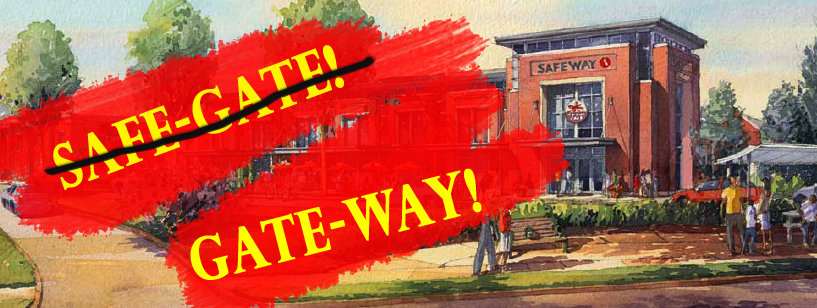
The transit-oriented-denialist group the Alliance for Rational Development published a poll regarding the Tenleytown Safeway a few days ago. Not content to only use sockpuppets to create the appearance of debate, they have gotten into push-polling. Yes, they created a voluntary internet poll, one that suffers badly from both self-selection bias and leading questions. For example:
I would prefer a mixed-use development on the site that would include five or six floors of residential housing along with a new Safeway. (Safeway at present, has indicated that it has no interest in building such a development.)
Out of 95 voters, 72 said yes to the question anyway. Then there’s this:
If you expressed a preference for a mixed-use development, would you still oppose Safeway’s current proposal if the result were that Safeway decided against any redevelopment of the current store?
81% of respondents still said yes. But all this poll indicates is that activists overwhelmingly support a Safeway mixed-use project. A self-selected poll is never accurate for representing a general population, as it attracts only the most interested individuals. This survey does not, and never could have represented neighborhood opinion, even more so than the Safeway postcards.
So, I guess my point is that ARD doesn’t represent the silent majority, and they don’t even represent a significant minority. The secretive organization is nothing but sound and fury crippled by ineptitude and a lack of web savvy. I don’t think they represent even a credible opposition – and they certainly don’t support anything on their own. Hopefully, people will see through their bluster and realize that they are done.
Alas, maybe more radical action is needed. MaKrel, who may or may not be my friends at ASR, suggests something more radical:
We could demolish the Safeway and return the land to agricultural production in a cooperatively owned CSA farm. Then we wouldn’t have to eat the GM cr*p that corporate supermarket chains shove down our throats; a good example: http://www.intervalecommunityfarm.com/
God Bless Anarcho-Syndicalism. I’ve taken a screencap of the poll just in case it goes down, after the break.
In Search of Lost Terms
I thought I’d join in on all the annual reflection this time of year by giving you some insight into where this website fits into the universe of architectural blogs. This past year, the top search topics for my site were:
- “DC metro map” in some form or another, at well over 300 hits;
- Neutra, which is surprising, considering I wrote one post about him;
- “Adjika,” also odd, in that I wrote one post about it;
- My own blog’s name,
- And Phil Freelon, also about whom I’ve only written once.
Nonetheless, I haven’t been getting too high on searches for Tenleytown – but this name theif is. What the hell? Sometimes, though, the results are a little more unusual:
After the GGW Meetup
At the GGW meetup this past week, Dan Reed or Matt Johnson reminded me of the segment of Koyaanisqatsi that shows the results of bad parts of civilization and… well just watch – with the volume up.
Oh, and this brings up all the year-end album collections getting thrown around. I’m going to spare the bloviation, and just give you some lyrics tangentially related to Pruitt-Igoe:
Fojol and 99 designs
I’m a bit overwhelmed with various jaints at the moment, but take a look at these prospective designs for the Fojol Bros. logo, made in a sort of capitalist fantasy called 99 Designs.
I’ve gotta say, though, the one I like the most is the one below. It’s so simple, yet so jaunty. I’m a fan of understatement (especially litotes), so even though this design doesn’t suit the Bros. too well, it deserves recognition.
Two accomplishments
I just saw these two things last night and thought they were impressive enough about what is possible with some elbow grease, a Ph.D, and a few billion dollars. So learn what it’s like to stand on the top of the Burj Dubai: It’s wobbly and tall. And it warms my heart to the hellhole that is Dubai. (gizmodo)
Closer to home, DARPA is paying the University of Maryland to weaponize maple seeds or samaras. That might seem insane, but watch the whole video to see what 3 years of research on single-wing rotary aircraft can get you. Go terps!? (hackaday)
Don’t get “samara” confused with the city in Russia, or samsara, or you may experience endless cycles of misunderstanding.
McMillan Two gets some feedback
Last week, I published the McMillan Two concept, after hearing about it on the Kojo Nnamdi show and interviewing the designer, Nir Buras. I’ve been pretty excited by the dialogue – the post of GGW received 88 comments and several thousand views. Others have jumped in.
First was the excellent constructive criticism by Alex Block. But he outdid himself with another article arguing for an ecologically balanced solution, which built on a post by…
…Mammoth, who delivered a strident critique of the more Eurocentric and anti-wetland flaws in the proposal. I commented on the article, and the exchanges between me, J.D. Hammond, and Rob Holmes are all good dialogue. The example of the Port Lands project in Toronto is worth examining in depth.
Straßgefühl, the only other blog whose name rivals mine, offers a counter-proposal based on the Sumidagawa river in Tokyo. The post opens up a new direction of thought, but it’s marred by insisting that Buras would be building a pseudo-historical development, since the proposal has no pretensions of history.
Obviously there was the news coverage too. BDC offered his thoughts, Ryan Avent jumped in with a skeptical but enthusiastic reception, JDLand noted that the plan exists, and DCist had its usual commentary.
If you’re still thirsty for information, you can look at the earlier reactions: City Block’s initial thoughts and then a look at precedents. Straßgefühl kinda-sorta liked it before; and Spencer Lepler was generally ok as well.
But it is great to see this kind of dialogue happening. The issues of nature, tradition, environment, autonomy, and culture have a lot of intersections not yet explored. The only thing everyone agreed on: tear down the highways. Interesting, no?
Bonus: Here’s an in depth article about Buras from Las Vegas Weekly. Read it!
Transit insanity in Perm
This gentleman in the Ural city of Perm had a close call with a bus, and no doubt is thanking the polar-bear-riding bible that is on Perm’s crest.

But what happened to the bus? Well, the brakes failed and it hit 16 other cars before getting stuck near a statue. All that after the break.